
Let me guess. You’ve watched a few crochet videos, maybe made a wobbly little square that looked more like a trapezoid, and now you’re staring at a beautiful handmade blanket online thinking, “There’s no way I could make that.”
Here’s the thing: you absolutely can.
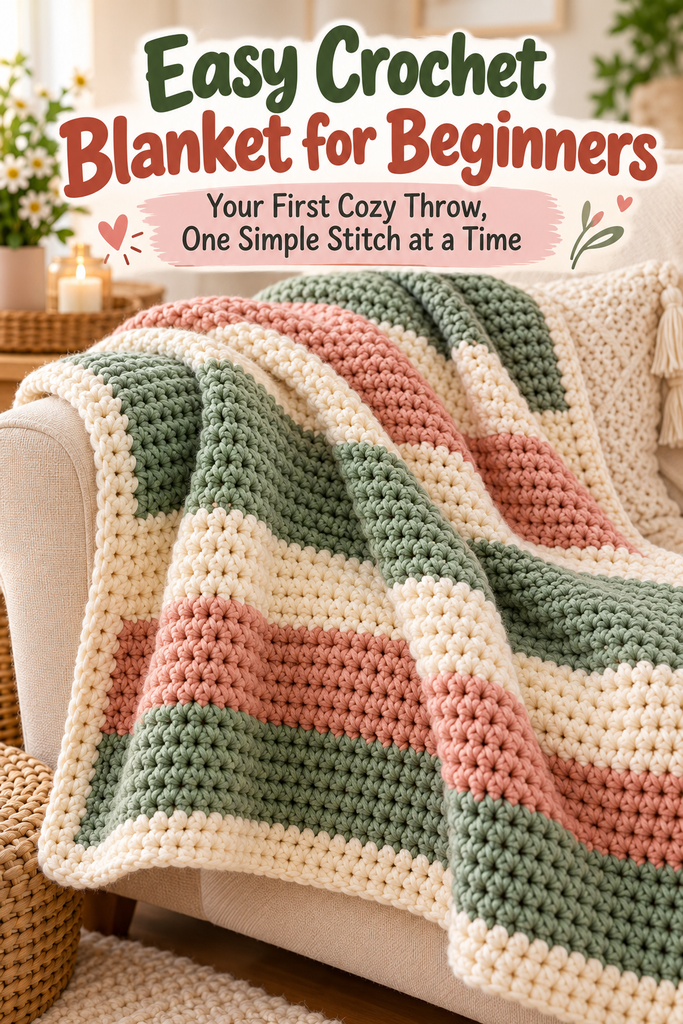
A blanket sounds like a huge project, but it’s really just one row repeated over and over. If you can make a single row, you can make a blanket. That’s not a pep talk. It’s literally how it works.
In this guide, I’ll walk you through an easy crochet blanket for beginners using just one stitch, the half double crochet. No color changes, no complicated charts, no counting headaches. Just you, some soft yarn, and a project that gets cozier with every row.
Table of Contents
Key Takeaways
- One stitch is enough. The half double crochet (hdc) builds a soft, sturdy fabric quickly and is very forgiving for new hands.
- Choose smooth, light-colored yarn. Worsted (#4) or bulky (#5) acrylic makes it easy to see your stitches.
- Count your stitches every few rows. It’s the single best habit for keeping your edges straight.
- Start small if you’re nervous. A baby blanket or lap throw gives you a finished project faster, and that win matters.
- Imperfect is fine. Your first blanket will have quirks. It’ll still keep you warm.
Why a Blanket Is Actually a Great First Project
Most people tell beginners to start with a scarf. And sure, scarves are fine. But have you noticed how many “first scarves” end up abandoned halfway through, slowly narrowing like a funnel?
A blanket has a few quiet advantages. It’s a simple rectangle, so you’re not shaping anything. It’s repetitive, which means your hands learn the motion fast. And honestly, there’s something deeply motivating about watching a blanket grow across your lap on a cold evening.
The repetition is the secret. By row ten, your tension evens out. By row thirty, you’re crocheting while watching TV. That’s when it stops feeling like a task and starts feeling like a hobby.
What You’ll Need (It’s a Short List)
You don’t need a craft room full of supplies. Here’s everything for this project:
- Yarn: Worsted weight (#4) or bulky weight (#5) acrylic or cotton blend. Pick a solid, light color.
- Crochet hook: 5.5 mm (US I-9) for worsted yarn, or 8 mm (US L-11) for bulky. Always check the yarn label; it usually suggests a hook size.
- Scissors for cutting yarn.
- Yarn needle (a blunt, large-eye needle) for weaving in the ends.
- Stitch markers (optional but very helpful). A safety pin or paperclip works in a pinch.
How Much Yarn Do You Need?
This is the question everyone asks, and the honest answer is “it depends on your size and tension.” As a rough starting point with worsted weight yarn:
- Baby blanket (about 30 × 36 in / 76 × 91 cm): roughly 1,000–1,200 yards
- Lap throw (about 40 × 50 in / 100 × 127 cm): roughly 1,600–1,900 yards
- Couch throw (about 50 × 60 in / 127 × 152 cm): roughly 2,200–2,600 yards
My advice? Buy one extra skein from the same dye lot. Running out of yarn three rows from the finish line, then discovering the store’s new batch is a slightly different shade, is a heartbreak you don’t need.
A Quick Word on Choosing Beginner-Friendly Yarn
It’s tempting to grab the fluffiest, most gorgeous yarn on the shelf. I get it. But fuzzy, dark, or novelty yarns hide your stitches, and when you can’t see your stitches, you can’t tell where to put the next one.
For your first blanket, look for yarn that is smooth, light or medium in color, and not too splitty (meaning the strands don’t separate easily when your hook goes through). A basic acrylic is affordable, machine washable, and perfectly soft enough to snuggle under.
Save the velvet and chenille yarns for project number two. You’ll enjoy them more once your hands know what they’re doing.
The Only Stitch You Need: Half Double Crochet
The half double crochet sits right between the single crochet (short and dense) and the double crochet (tall and holey). It gives you the best of both: it grows faster than single crochet but stays warm and solid.
Quick note on terms: this pattern uses US crochet terms. In UK terms, the half double crochet is called a “half treble.” Same stitch, different name. It trips up a lot of people, so now you know.
How to Make a Half Double Crochet
- Wrap the yarn over your hook once (this is called a “yarn over”).
- Insert your hook into the next stitch.
- Yarn over again and pull up a loop. You now have three loops on your hook.
- Yarn over one more time and pull through all three loops.
That’s it. One stitch done. Do it a few hundred more times and you’ve got a blanket.
Step-by-Step Pattern: Easy Half Double Crochet Blanket
Before you start, here are the abbreviations you’ll see:
- ch = chain
- hdc = half double crochet
- sc = single crochet
- st(s) = stitch(es)
Step 1: Make Your Foundation Chain
Chain until the length matches the width you want for your blanket. For a lap throw in worsted yarn, that’s usually around 130–150 chains. Hold it up against yourself or a blanket you already own to check.
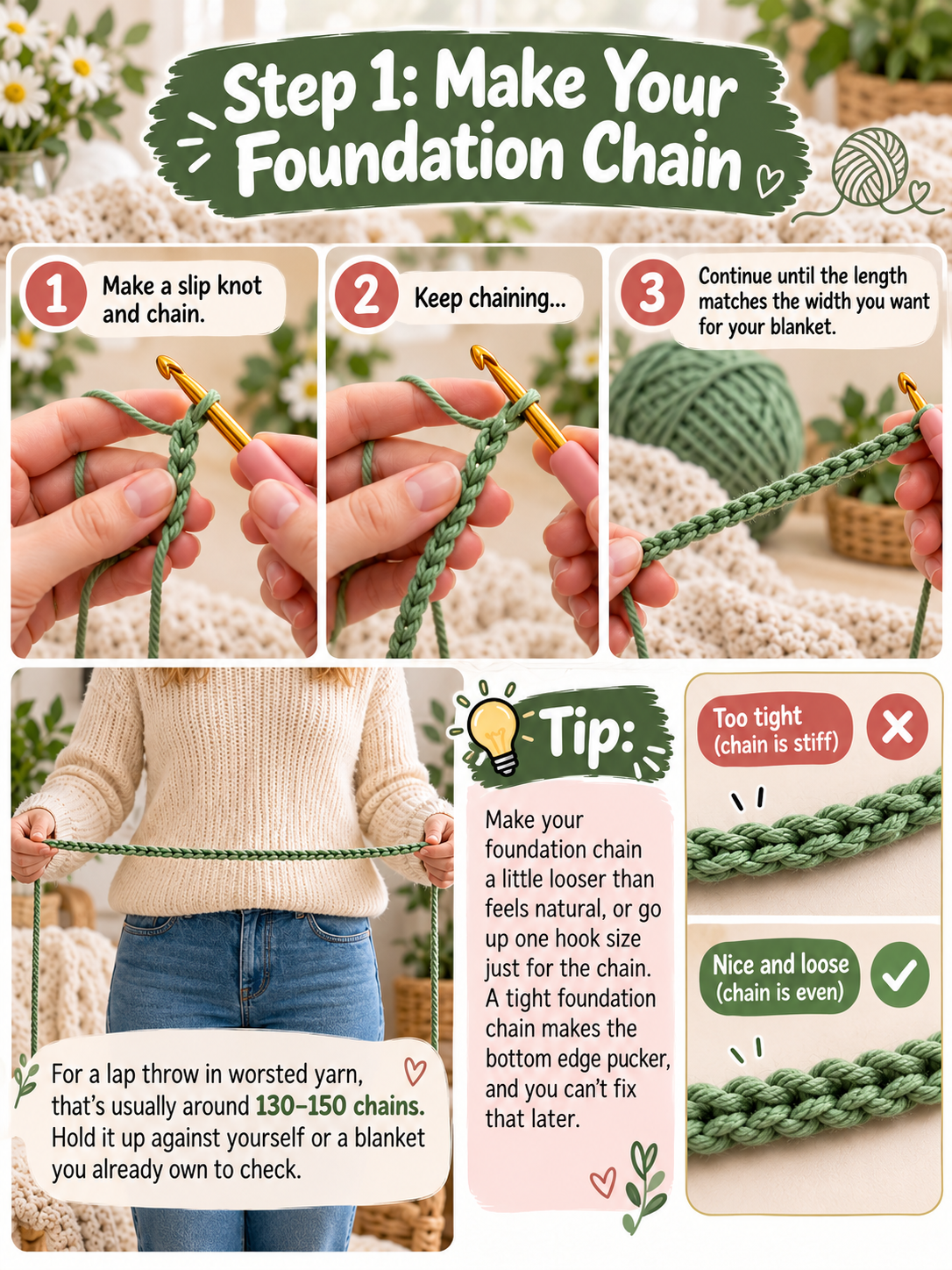
Tip: Make your foundation chain a little looser than feels natural, or go up one hook size just for the chain. A tight foundation chain makes the bottom edge pucker, and you can’t fix that later.
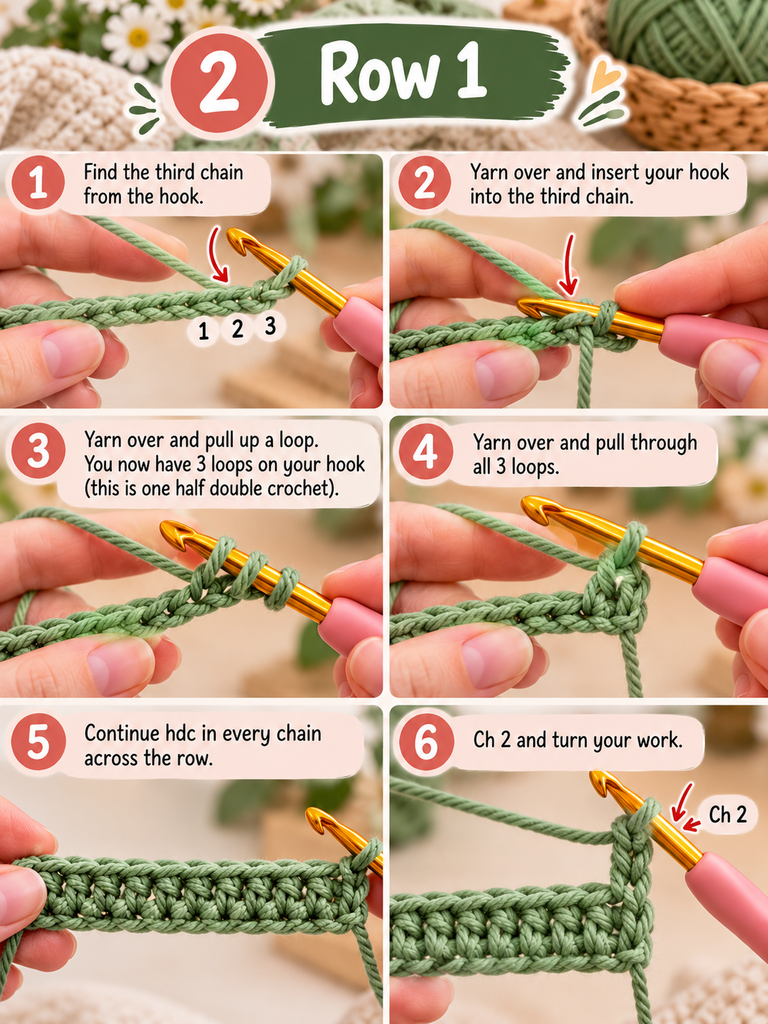
Step 2: Row 1
Hdc in the third chain from the hook. Then hdc in every chain across. Ch 2 and turn your work.
Step 3: Row 2 and Beyond
The ch 2 does not count as a stitch. Hdc in the very first stitch, then hdc in every stitch across the row. Ch 2 and turn.
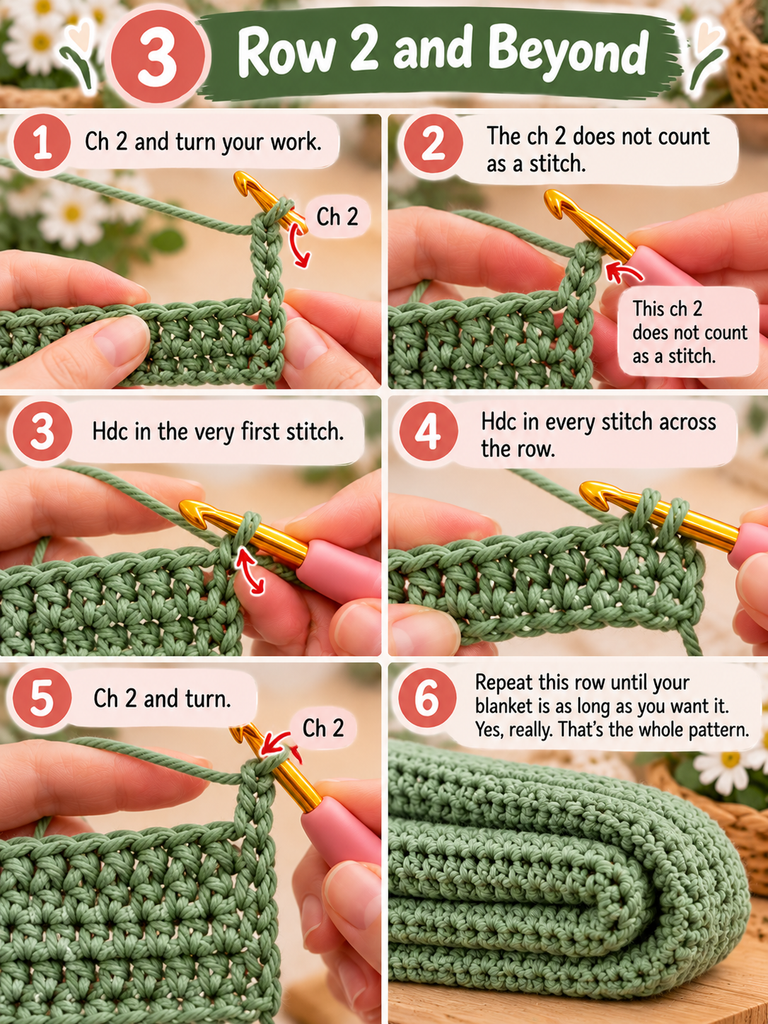
Repeat this row until your blanket is as long as you want it. Yes, really. That’s the whole pattern.
Step 4: Add a Simple Border
Once your blanket reaches the right length, don’t fasten off yet. Ch 1, then work a single crochet evenly around all four sides. Put 3 sc in each corner so the corners lie flat instead of curling. Join with a slip stitch to the first sc.
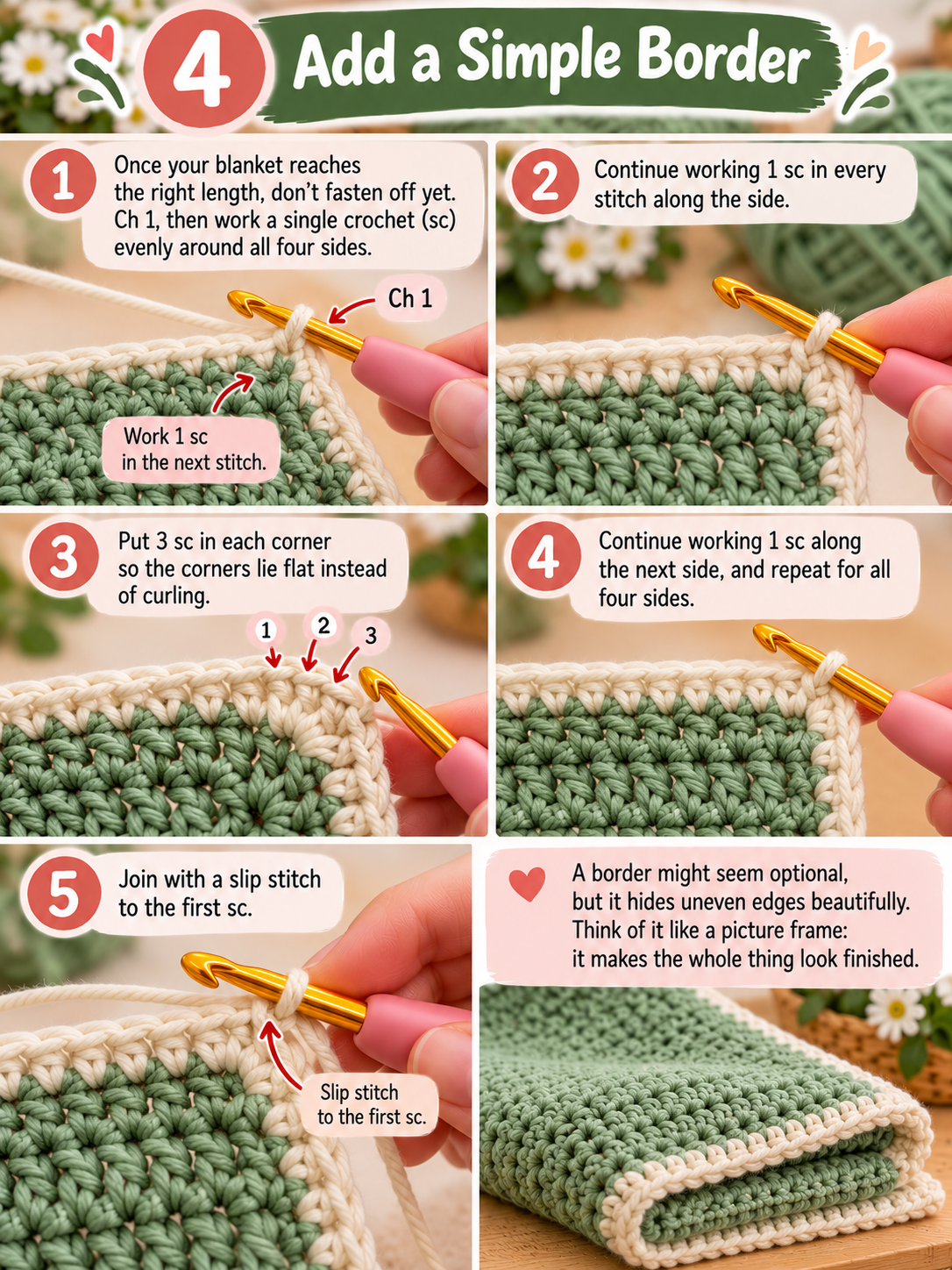
A border might seem optional, but it hides uneven edges beautifully. Think of it like a picture frame: it makes the whole thing look finished.
Step 5: Weave In Your Ends
Cut your yarn, leaving a 6-inch tail. Thread it onto your yarn needle and weave it back and forth through the stitches on the back side for a few inches in different directions. Do the same for every tail where you joined a new skein.
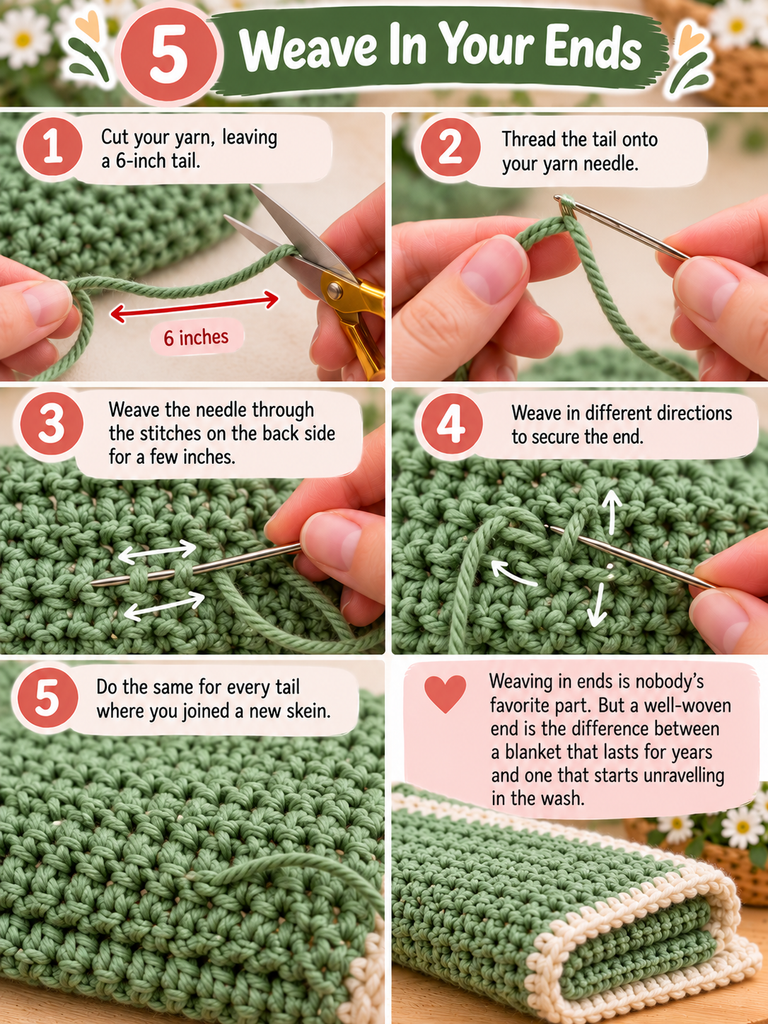
Weaving in ends is nobody’s favorite part. But a well-woven end is the difference between a blanket that lasts for years and one that starts unravelling in the wash.
Common Beginner Mistakes (and How to Fix Them)
We’ve all been there. Here are the problems I see most often, along with the fixes.
“My blanket is getting narrower (or wider)!”
This is the number one beginner issue, and it almost always happens at the edges. You either skip the first stitch or accidentally work into the turning chain. The fix: place a stitch marker in the first and last stitch of each row. When you reach the marker, you know exactly where to go. And count your stitches every five rows or so.
“My stitches are super tight.”
Totally normal. Tension relaxes with practice. Try holding the yarn a little looser in your non-hook hand, or simply go up a hook size. Nobody will know.
“I found a mistake ten rows back.”
Take a breath. If it’s a small thing like a slightly crooked stitch, leave it. Handmade items are supposed to look handmade. If it’s a big problem (like a dramatic slant), you can pull out the rows (crocheters call this “frogging” because you “rip it, rip it”) and redo them. It stings for a minute, then it’s fine.
“My edges look messy.”
That’s what the border is for. Seriously, a single crochet border fixes about 80% of edge drama.
Small Tips That Make a Big Difference
- Join new yarn at the end of a row, not in the middle. Ends are much easier to hide along the side.
- Crochet in short sessions at first. Twenty minutes a day beats a three-hour marathon that leaves your wrist sore.
- Take a photo every week. Progress is hard to notice up close. Looking back at old photos is surprisingly motivating.
- Keep your project in a bag. Pets love yarn more than you do.
- Read the yarn label for washing instructions before you gift the blanket, and pass that info along.
Ready for a Little Variety? Easy Ways to Level Up
Once you’ve finished your first blanket (and you will), you might want to try something a bit different without diving into anything complicated. A few beginner-friendly next steps:
- Stripes: Same pattern, but switch colors every few rows. It’s the easiest way to make a blanket look “designed.”
- Moss stitch (also called linen stitch): Alternating single crochets and chains for a woven, textured look.
- Granny stripe: A classic, cheerful pattern made with clusters of double crochet. Great for using up leftover yarn.
- Chunky yarn blanket: Use super bulky (#6) yarn and a big hook for a blanket you can finish in a weekend.
Frequently Asked Questions
How long does it take to crochet a blanket as a beginner?
It varies a lot. A baby blanket might take a couple of weeks of casual evenings, while a full couch throw could take a month or more. Bulky yarn and a larger hook will speed things up considerably.
What is the easiest crochet stitch for a blanket?
Half double crochet and single crochet are the easiest. Half double crochet grows faster, which is why I recommend it for a first blanket.
Can I use any yarn for a beginner blanket?
Technically yes, but smooth worsted or bulky yarn in a light color will make your life much easier. Avoid very fuzzy, dark, or textured yarns until you’re comfortable reading your stitches.
Do I need to check gauge for a blanket?
Not really. Gauge matters for things that need to fit, like sweaters. For a blanket, a little bigger or smaller is fine. Just keep in mind that a looser gauge uses more yarn.
Your First Blanket Is Closer Than You Think
Remember that wobbly first square I mentioned at the start? Every crocheter has one tucked away somewhere. The people making stunning blankets today all began exactly where you are now: one chain, one row, one slightly uneven edge at a time.
This easy crochet blanket for beginners isn’t about perfection. It’s about sitting down, making the next stitch, and slowly building something warm with your own hands. And when you finally wrap yourself in it (or hand it to someone you love), you’ll know every row was worth it.
So grab a hook, pick a yarn you love, and chain that first row tonight.
Now I’d love to hear from you: what color are you choosing for your first blanket, and who’s it for? Drop it in the comments below. And if you get stuck at any point, ask away. Chances are someone else is wondering the exact same thing.


One Comment