

Every year it happens the same way. The first chilly evening shows up, I reach for a blanket on the couch, and I realize the one I’ve been using is a sad, pilled thing I bought on sale years ago. That’s usually the night I start shopping my stash.

If you’re feeling that same itch right now, let me save you an hour of scrolling. The Autumn Log Cabin Throw by the Red Heart Design Team is the project I keep coming back to, and I’m going to show you exactly why. It’s labeled easy, it’s free, and it looks like it took far more skill than it actually does.
Table of Contents
Key Takeaways
- Skill level: Easy. If you can single crochet and count to three at the corners, you can make this.
- Finished size: 72″ x 72″, built from 36 square motifs that each measure 11½”.
- Yarn: Red Heart Super Saver (worsted weight) in 7 colors, with a 5mm (US H-8) hook.
- Cost of the pattern: Nothing. It’s a free PDF download on Yarnspirations, and no sign-up is required.
- Best part: Change the seven colors and you get a completely different blanket, from cozy fall to modern pink-and-charcoal.
Why a Log Cabin Blanket Feels So Good to Make
“Log cabin” comes from quilting. Quilters build a block by starting with a small center square and adding strips, one after another, around it. The strips look like logs stacked around a hearth, which is where the name comes from.
Crochet borrows the same idea, and honestly, it suits crochet even better. You don’t cut anything. You don’t sew strips together. You just join a new color and keep going.
Here’s the part I love most: every section is short. Five rows, fasten off, new color. You never get stuck in that endless middle stretch where a blanket feels like it will never end. Each motif gives you seven tiny “finish lines,” and that keeps you coming back to the hook night after night.
What You’ll Need
The original pattern was written for Red Heart Super Saver, which is about as easy to find as yarn gets. Here’s the full list from the pattern, along with the color names so you can shop (or swap) with confidence:
- Color A – Carrot (256): 1 skein
- Color B – Ranch Red (332): 1 skein
- Color C – Frosty Green (4361, a fleck yarn): 3 skeins
- Color D – Café (360): 4 skeins
- Color E – Cornmeal (320): 4 skeins
- Color F – Claret (378): 4 skeins
- Color G – Buff (334): 4 skeins
- 5mm (US H-8) crochet hook
- Yarn needle
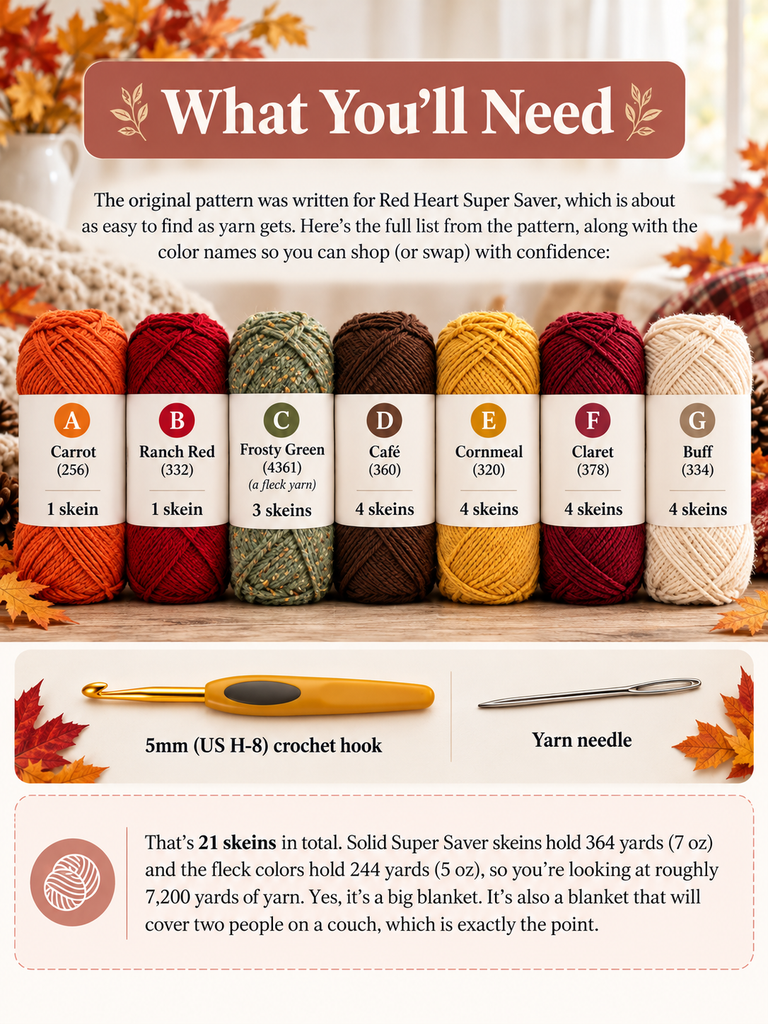
That’s 21 skeins in total. Solid Super Saver skeins hold 364 yards (7 oz) and the fleck colors hold 244 yards (5 oz), so you’re looking at roughly 7,200 yards of yarn. Yes, it’s a big blanket. It’s also a blanket that will cover two people on a couch, which is exactly the point.
A quick tip on gauge: one finished motif should measure 11½” square. The pattern says to use whatever hook gets you there. Make one motif first and measure it before you commit to all 36. Trust me, it’s far less painful than finding out at motif number twenty that your blanket is going to be 80″ wide.
How the Autumn Log Cabin Throw Is Built
You won’t find the full row-by-row pattern here (that lives in the free PDF, and the designers deserve the click). What I want to give you is the big picture, because once you understand how the motif grows, the written instructions suddenly make a lot more sense.
The center square
Each motif starts with a tiny square in Carrot, worked in three rounds. You’ll make a small ring of single crochet, add some texture, and finish with half double crochet corners. It’s small, bright, and it sets the “hearth” of your log cabin.
The “logs”
From there, you add six more sections, each in its own color. Here’s the trick that makes this pattern special: each section is worked in rows across two sides of the square at once, with three stitches worked into the corner to turn it. So every color forms an L-shape that wraps around the corner of the previous section.
Picture a stack of chevrons nesting into each other, getting bigger and bigger. That’s your motif.
The texture
This isn’t just plain single crochet, and that’s what lifts it above a basic blanket. Some sections use a long double crochet, which reaches down into the row below. Others use a long half double crochet worked over a chain space. Both create little raised dashes that catch the light and make the stripes look woven.
Don’t let the word “long” scare you. It’s simply a regular stitch where you insert your hook a row lower than usual and pull the loop up to the height of the row you’re on. After the first three or four, your hands will figure it out.
The finish
Each motif gets a border round in Buff. Then you sew the 36 squares together following the diagram in the PDF, six across and six down. Because each motif is lopsided by design (color on two sides, not all four), turning the squares in different directions creates a bigger pattern across the whole throw. Finally, a five-round outer border in Ranch Red, Cornmeal and Claret frames everything.
“What Do the Brackets Mean?” (A Question I Hear a Lot)
If you’ve ever stared at a line like [sc in next 3 sts, 3 hdc in next st] 3 times and felt your brain go blank, you’re not alone. I’ve seen this exact question pop up in comment sections more than once.
Here’s the simple answer. Square brackets mean “do everything inside these brackets, then repeat that whole group the number of times written after them.”
So [sc in next 3 sts, 3 hdc in next st] 3 times means:
- Single crochet in the next 3 stitches, then 3 half double crochets in the next stitch.
- Do that again.
- And once more.
The asterisk (*) works in a similar way. Everything after it is a set you’ll be told to repeat, usually with a phrase like “repeat from * twice more.” Once that clicks, this pattern reads like a recipe instead of a puzzle.
Five Color Stories to Steal
The original autumn palette is gorgeous, all warm browns, golds and berry reds. But one of the best things about this throw is how completely it changes with new colors. Crocheters on Ravelry have taken it in some wonderful directions. Here are five versions that made me stop scrolling.
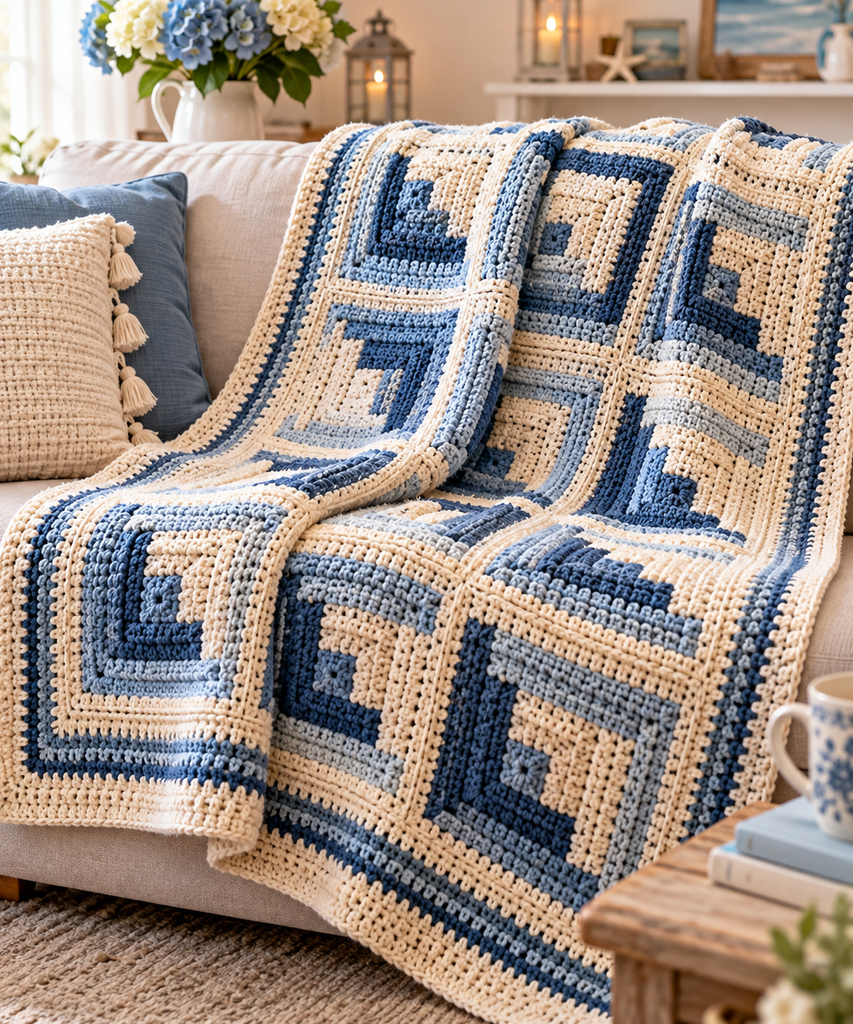
1. Cream and Blue: Calm and Classic
Swap the warm tones for creamy beige and soft blues and you’ve got something that feels like a seaside cottage. This one would look just as good in July as in November. Choose the softest yarn you can find here, because this is the kind of blanket that gets used.
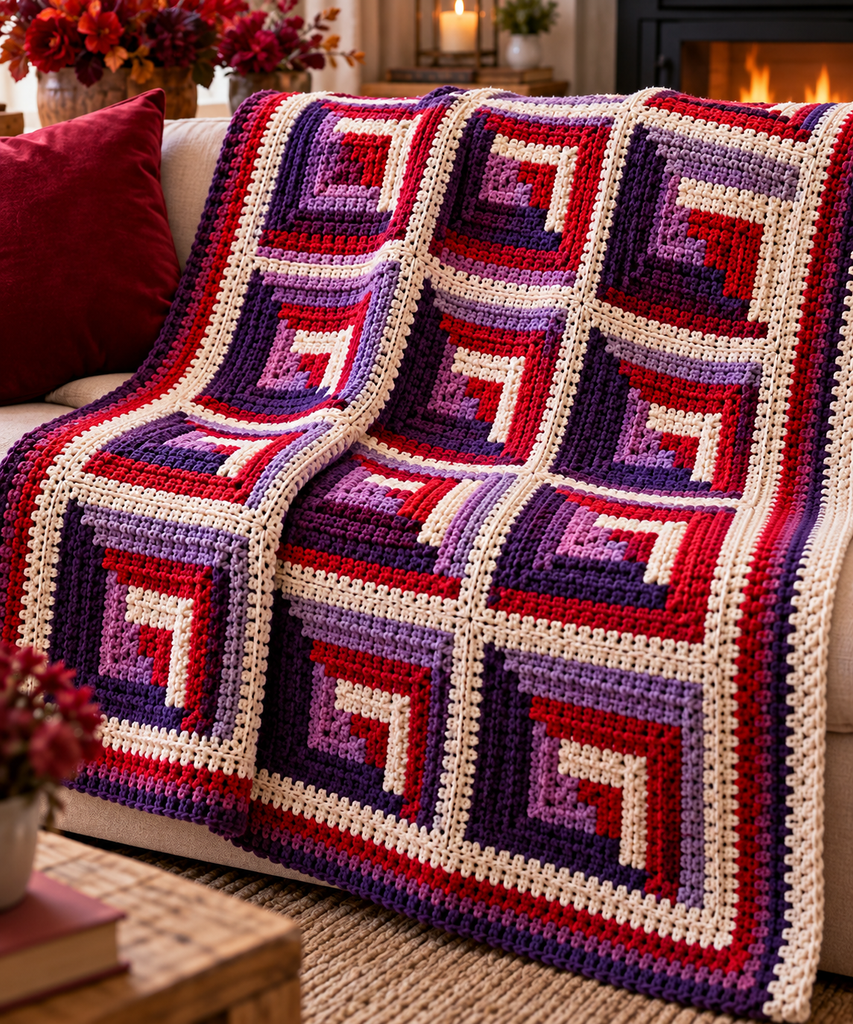
2. Violet and Red: Bold and Graphic
If you like color that makes a statement, this is your version. Deep violets and reds push the geometric layout forward, so the whole blanket almost looks like a modern art print. It’s a great reminder that the “logs” become stripes, and stripes love contrast.
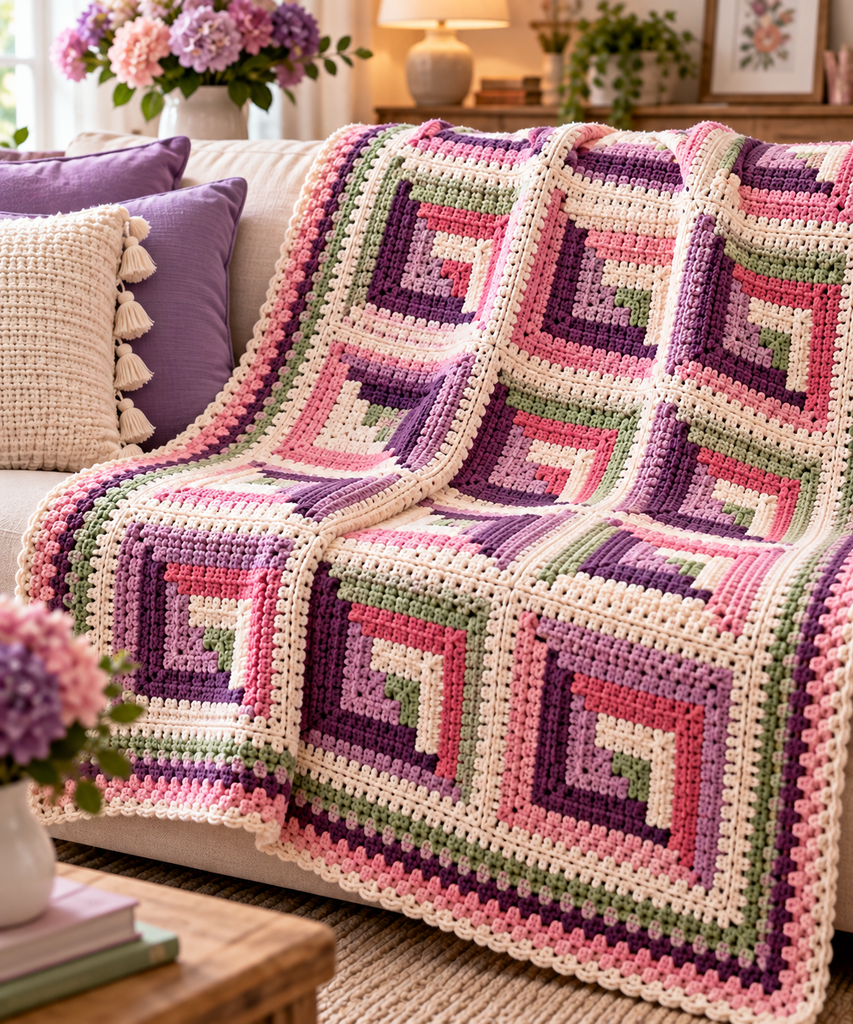
3. Pink, Purple and Cream: Soft and Elegant
This palette mixes cream with purple and pink, and then adds a small touch of light green. That one pop of green is the secret. It keeps the blanket from feeling too sweet and gives your eye somewhere to land.
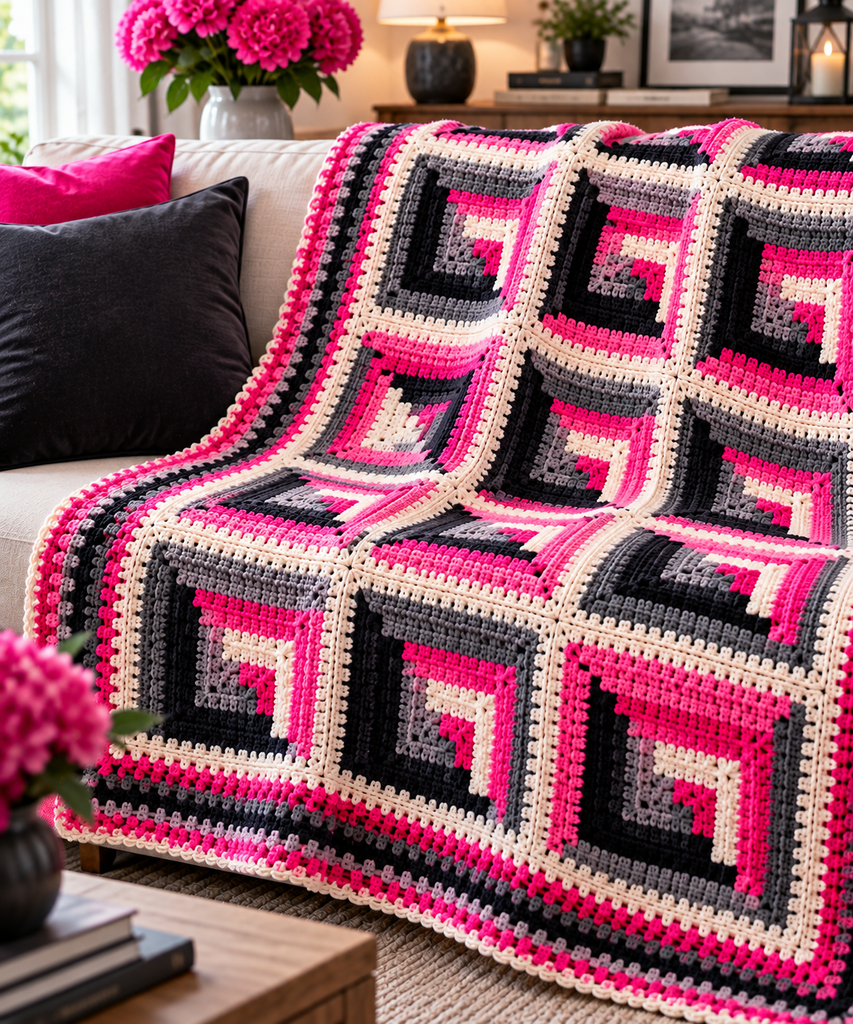
4. Electric Pink with Charcoal and Black: Modern Edge
Bright pinks paired with dark grey and black? It sounds risky, and it absolutely works. The dark shades ground the brights, so the blanket reads modern rather than girly. If your living room is all clean lines and neutral furniture, this one could be your new favorite accent.
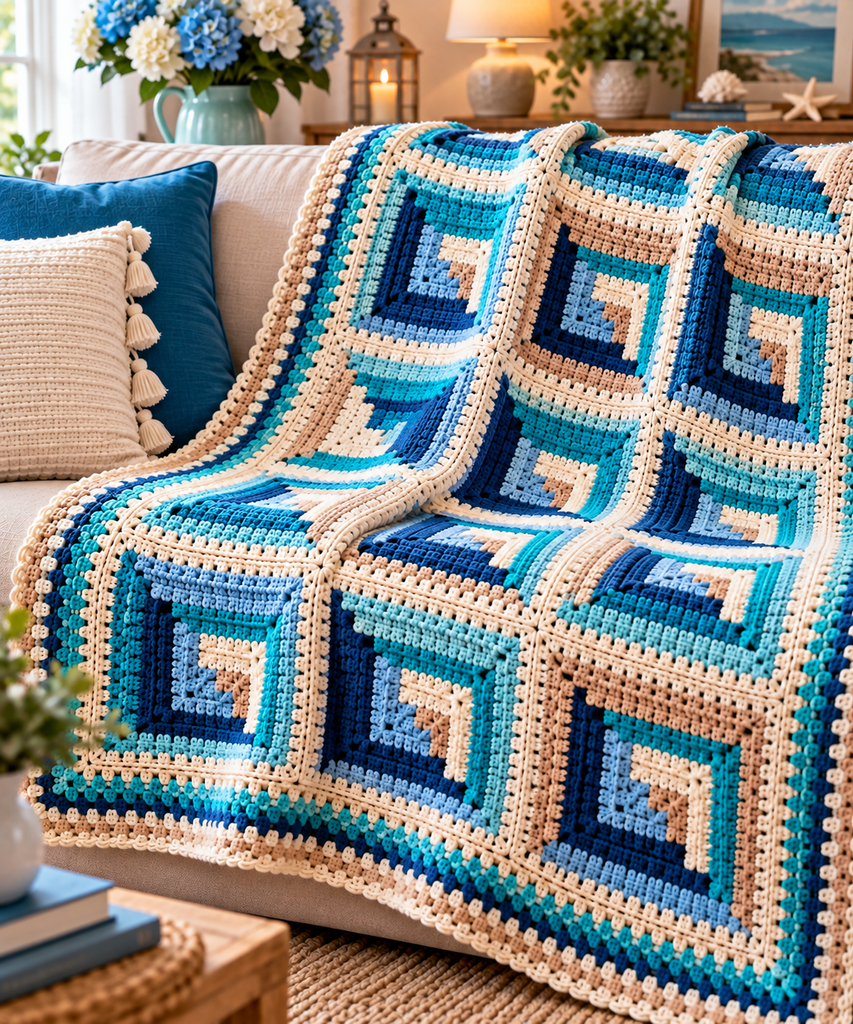
5. Turquoise, Blue and Beige: Fresh and Soothing
Turquoise and blue have such a restful feel, and the beige keeps them from looking cold. It’s an unexpected combination for a pattern with “autumn” in the name, which is exactly why I like it.
How to Plan Your Own Palette
Choosing seven colors at once can feel overwhelming. Here’s the simple method I use:
- Pick your center color first. It’s tiny, so this is where you can go bright. Think of it as the spark in every square.
- Choose a light, a medium and a dark. Sections D through G use the most yarn (4 skeins each), so these four colors decide the overall mood. Mixing values (light vs. dark) matters more than mixing hues.
- Save one “frame” color for the motif borders. In the original, Buff plays this role. A neutral here pulls everything together when the squares are sewn up.
- Test before you buy 21 skeins. Wrap a few strands of each color around a piece of cardboard in the order they’ll appear. Squint at it. If two colors blur together, swap one out.
My Best Tips for a Smoother Make
- Weave in ends as you go. Each motif has seven color changes. Multiply that by 36 and you’ve got a mountain of tails. Ten minutes after each motif beats a whole weekend at the end.
- Mark your corner stitch. Almost every row hinges on finding the center corner stitch and working 3 sc into it. A stitch marker there saves a lot of frogging.
- Check your stitch counts. The pattern gives you a count at the end of nearly every row. Use them. If you’re off by one, it’s much easier to fix now than three rows later.
- Batch your motifs. Some crocheters like to make all 36 center squares first, then all the Section 2s, and so on. It keeps you in a rhythm and cuts down on switching yarn.
- Lay it out before you sew. Arrange all 36 squares on the floor (or a bed) following the diagram. Take a photo. Then seam. Rotating a square the wrong way is easy to miss until it’s stitched in.
Caring for Your Finished Throw
Since this is made in acrylic Super Saver, care is easy. The pattern page recommends machine washing in warm water on a gentle cycle and tumble drying on low. Skip bleach and don’t iron it. That means you can actually use this blanket for movie nights, snacks and pets, and toss it in the wash without worrying.
Frequently Asked Questions
Is the Autumn Log Cabin Throw good for beginners?
It’s rated easy. If you’re comfortable with single crochet, half double crochet and double crochet, and you can read a basic pattern, you’re ready. The long stitches are the only new thing, and they’re simple once you try them.
Is the pattern really free?
Yes. It’s available as a free PDF from Yarnspirations, and the download doesn’t require creating an account. That’s good news if you’ve been frustrated by “free” patterns that send you through login pages.
Can I make it smaller?
Definitely. Because it’s made from 11½” squares, you can simply make fewer of them. Nine motifs (3 x 3) gives you a lap blanket around 35″ square before the border. Sixteen motifs (4 x 4) lands around 46″. Just remember to reduce your yarn amounts to match.
Can I use a different yarn?
Any worsted weight (#4) yarn should work. Just make a test motif and check it against the 11½” gauge before you buy everything.
Ready to Cozy Up?
Remember that sad old blanket I mentioned at the start? That’s the real reason this pattern sticks with me. It’s not just a project. It’s the thing you’ll grab every cold evening for years, built one five-row “log” at a time.
The Autumn Log Cabin Throw proves that easy doesn’t have to mean plain. A small center square, a handful of stitches, seven colors and a little patience, and you’ve made something that looks like an heirloom.
You can download the free pattern from Yarnspirations here: Red Heart Autumn Log Cabin Throw.
Now I want to hear from you. Which version would you make: the classic autumn tones, or one of the color twists above? Have you made a log cabin blanket before? Tell me in the comments, and if you finish one, share a photo. I’d love to see what colors you picked.