
There’s a particular kind of magic in watching a plain ball of yarn turn into a flower that never wilts. If you’ve ever scrolled past a basket of crocheted daisies on Pinterest and thought, I wish I could make that, I promise you’re closer than you think. Flowers are, hands down, one of the friendliest places to start (or restart) your crochet journey. They’re small, forgiving, fast, and best of all they teach you the exact skills you’ll lean on for bigger projects like garments, blankets, and appliqués.
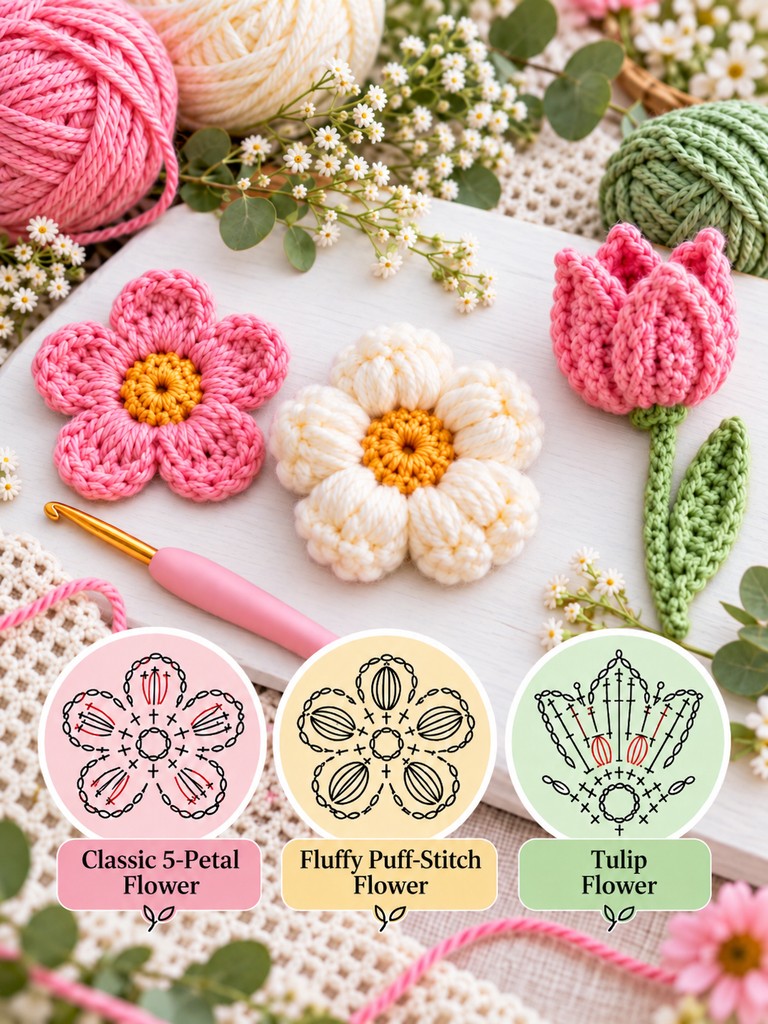
In this guide, I’m walking you through three genuinely beginner-friendly flower patterns, each with a clear stitch-by-stitch breakdown. No confusing shorthand dumped on you without explanation, no assuming you already know what a “puff stitch” is. By the end, you’ll have a little bouquet of your own and the confidence to start improvising.
Table of Contents
Key Takeaways
- All three patterns use basic stitches (chain, single crochet, half double crochet, double crochet) — no advanced techniques required
- Each flower can realistically be finished in 20–45 minutes, making them perfect “quick win” projects
- You’ll learn the difference between rounded petals, pointed petals, and puff-stitch petals — the building blocks of almost every crochet flower design
- These flowers work as appliqués, bouquet stems, garlands, brooches, or embellishments on hats, bags, and blankets
- A worsted weight (US 4) yarn and a 4.0–4.5mm hook will get you through every pattern below
What You’ll Need To make Crochet Flower Patterns
The beauty of crochet flowers is that they’re scrap-yarn projects you genuinely don’t need to buy anything special to get started.
Materials:
- Worsted weight yarn (US 4 / “medium”), in your choice of colors leftover skeins work great
- A 4.0mm (US G/6) or 4.5mm (US 7) crochet hook
- Scissors and a yarn needle for weaving in ends
- Optional: a button, bead, or contrasting scrap of yarn for flower centers
Abbreviations used in this guide (US terms):
| Abbreviation | Meaning |
|---|---|
| MR | Magic ring |
| ch | Chain |
| sl st | Slip stitch |
| sc | Single crochet |
| hdc | Half double crochet |
| dc | Double crochet |
| st(s) | Stitch(es) |
| rep | Repeat |
If any of these are new to you, it’s worth practicing them on a scrap swatch first — five minutes of practice will save you a lot of frustration mid-pattern.
Pattern 1: The Classic 5-Petal Flower (The Easiest Crochet Flower for Beginners)
This is the flower I’d hand to someone who’s never made anything but a chain before. It uses only three stitch types and comes together in one continuous round — no counting rows, no shaping, no fuss. If you’re wondering which flower is the easiest to crochet, this is genuinely it.
Round 1:
Make a magic ring. Ch 1 (this does not count as a stitch). Work 10 sc into the ring. Pull the tail tight to close the ring, then join with a sl st to the first sc. (10 sts total)
Round 2 — Forming the Petals:
Skip the next st, then work (sl st, ch 3, 3 dc, ch 3, sl st) all into the following st. Repeat from * around the ring. You should end up with 5 petals, each anchored into every other stitch from Round 1.
Fasten off, leaving a short tail, and weave in your ends.
Why this works so well for beginners: every petal is built the same way, so once you’ve made one, your hands already know how to make the rest. It’s essentially the crochet equivalent of a stuck record — in the best way.

Optional finishing touch: sew a button, bead, or small pom-pom into the center for extra texture.
Pattern 2: The Fluffy Puff-Stitch Flower
If you’ve searched how to crochet fluffy flowers, this is the technique you’re picturing — that soft, dimensional, slightly bobbly texture that makes a flower look almost knitted or felted. The secret is a stitch called the puff stitch, and once you learn it here, you’ll spot it everywhere in crochet patterns.
How to work a puff stitch:
Yarn over, insert your hook into the stitch, yarn over again and pull up a loop (make this loop a little taller than usual don’t pull it tight). Repeat this three more times into the same stitch you’ll have 9 loops on your hook. Yarn over one final time and pull through all 9 loops. Chain 1 to close and lock the puff in place.
Round 1:
Magic ring, ch 1, 6 sc into the ring. Join with a sl st to the first sc and pull the tail closed. (6 sts)
Round 2 Puffed Petals:
Ch 2 (does not count as a stitch). Work one puff stitch into the next st, then ch 1. Repeat from * around, working one puff stitch into each of the 6 stitches. Join with a sl st to the top of the very first puff.
Fasten off and weave in ends.
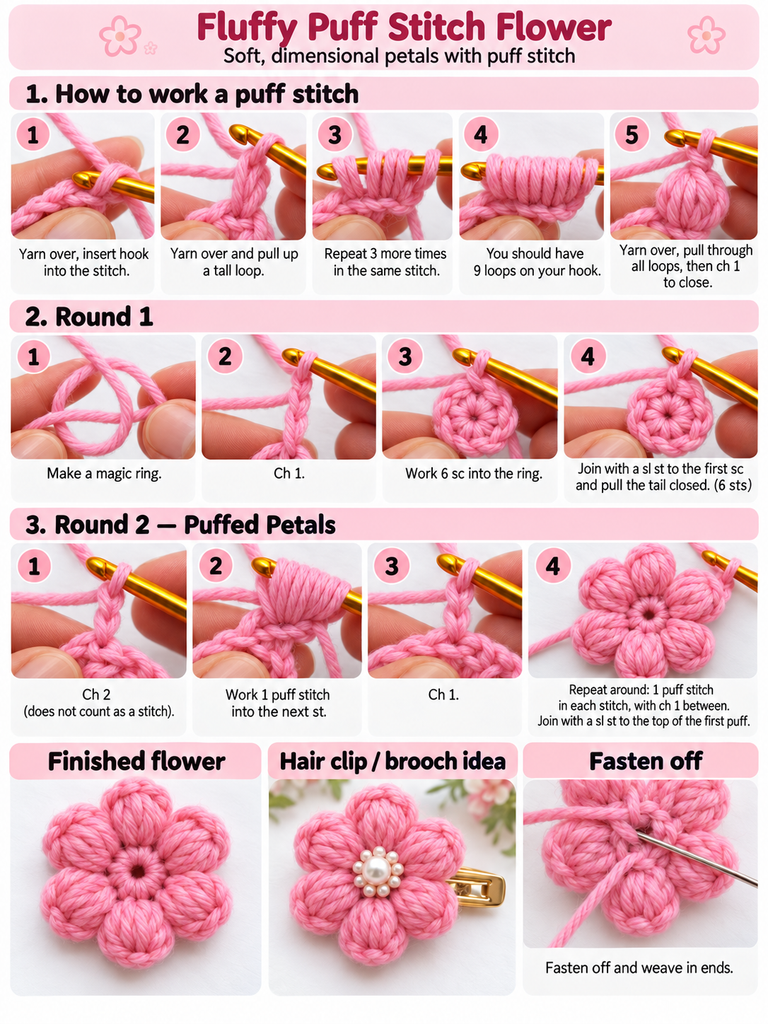
Pro tip: work this in a slightly plumper, low-twist yarn (like a chenille or a soft cotton blend) and the fluffiness practically triples. This is also the flower that photographs beautifully as a hair clip or brooch, since the puffed petals catch the light so nicely.
Pattern 3: The Little Tulip
Tulips are a favorite because their pointed petals give you a completely different silhouette from the round, daisy-style flowers above and honestly, once you can crochet a tulip, you understand petal-shaping in a whole new way. Here’s how to make a crochet tulip flower step by step, plus a simple stem and leaf so you can display it standing up in a little vase.
Round 1 (Flower base):
Magic ring, ch 1, 6 sc into the ring. Join with a sl st and close the ring. (6 sts)
Round 2 Pointed Petals:
Ch 4, sc into the 2nd ch from the hook, hdc into the next ch, dc into the next ch, then sl st into the same stitch at the base of the petal. Repeat from * into each of the 6 stitches around. You’ll finish with 6 tall, pointed petals that naturally curl inward the signature tulip shape.
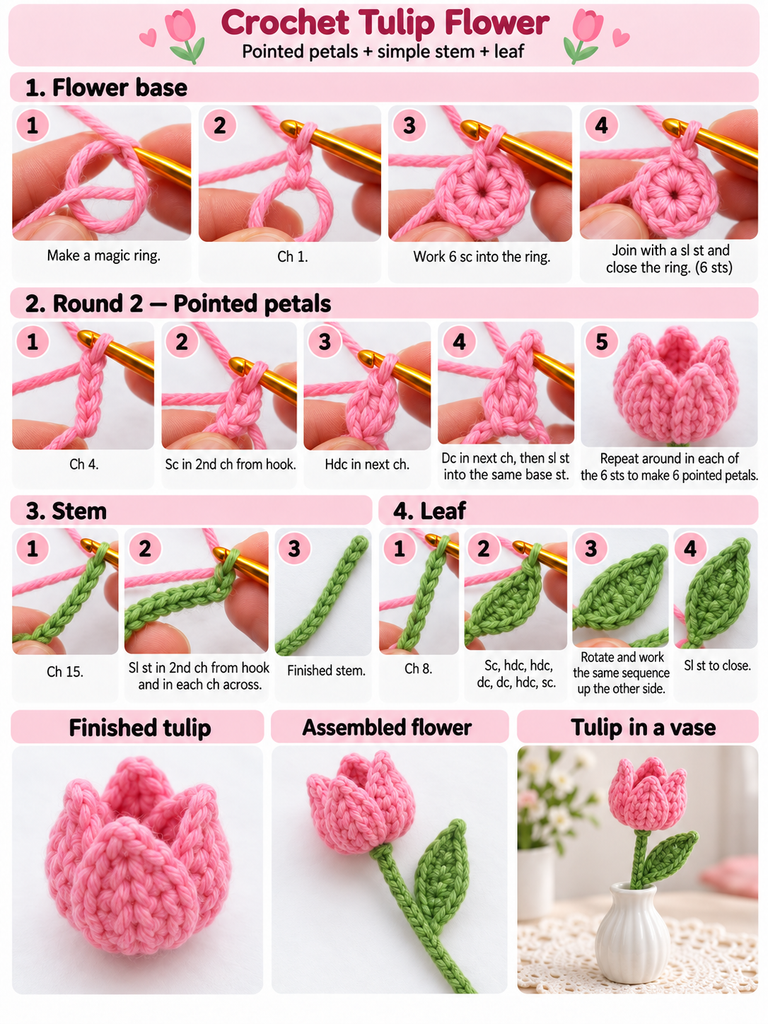
Fasten off, weave in the end.
Stem:
Chain 15 (or longer, to taste). Working back down the chain: sl st into the 2nd ch from hook and into each ch across. Fasten off.
Leaf:
Chain 8. Starting in the 2nd ch from hook: sc, hdc, hdc, dc, dc, hdc, sc. When you reach the end of the chain, don’t fasten off rotate and work back up the other side of the same chain with the same sequence (sc, hdc, hdc, dc, dc, hdc, sc), then sl st to close. Fasten off.
Attach the flower to the top of the stem and stitch the leaf partway down and there’s your tulip, ready for a bouquet.
What Crochet Stitch Looks Like a Flower?
Beyond the three patterns above, there’s a whole family of stitches designed specifically to mimic floral shapes. Here’s a quick tour so you can recognize (and eventually try) them:
- Puff stitch the fluffy, rounded texture used in Pattern 2 above
- Popcorn stitch similar to a puff, but worked with full double crochets and pulled tight for a firmer, bobble-like bump
- Cluster stitch a small grouping of stitches worked together at the top, creating a fan or shell-like petal
- Lotus stitch a layered technique that builds petals in overlapping tiers, giving a very realistic, dimensional bloom
- Jasmine stitch a delicate, star-shaped stitch traditionally used for lacy flower motifs and doilies
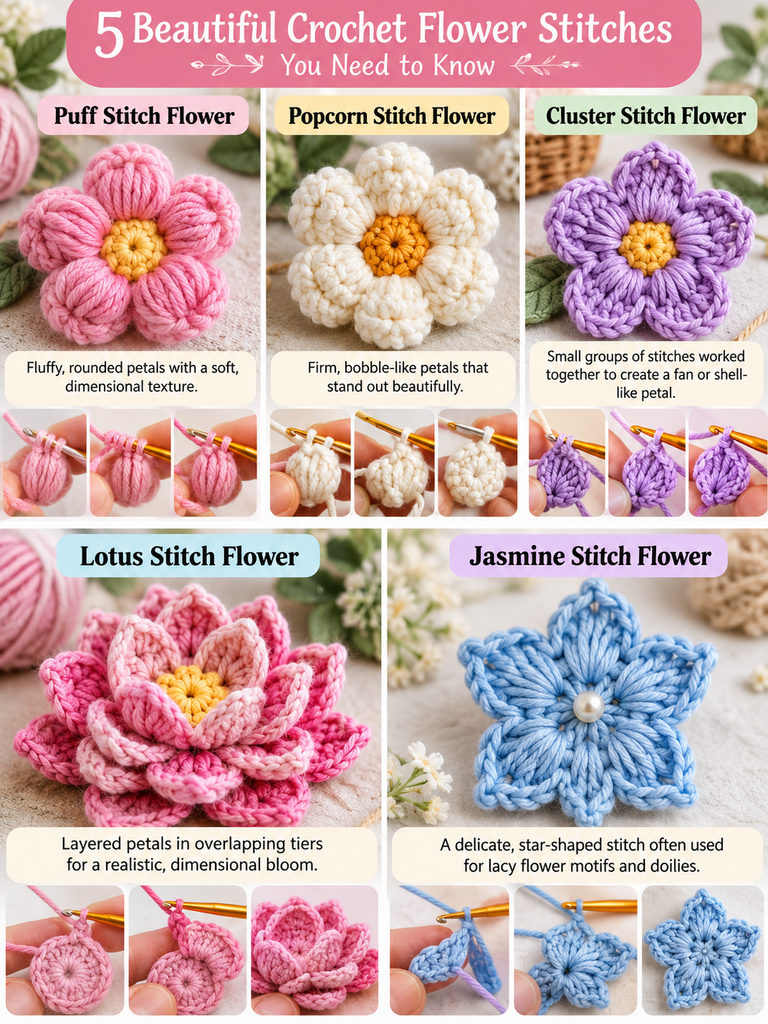
If you enjoyed the tulip’s pointed petals, the lotus and jasmine stitches are a natural next step once you’re ready to level up.
What’s the Best Yarn for Crochet Flowers?
Honestly, this depends on the look you’re after:
- Cotton yarn gives crisp, defined petal edges ideal if you want a clean, structured flower (like appliqués for bags or garments)
- Acrylic worsted weight is the most forgiving and budget-friendly option, and it’s what I’d recommend for your first attempt at any of these three patterns
- Chenille or velvet-style yarn creates that ultra-fluffy look, perfect for the puff-stitch flower
- Wool or wool blends hold their shape beautifully and are great if the flower will get any wear (like on a hat or bag)
A 4.0mm hook is a safe, versatile default across almost all of these yarn types.
What Can I Crochet in 2 Hours? (Turning These Into a Bouquet)
Here’s the fun part because each flower takes 20–45 minutes, you can realistically crochet an entire small bouquet in an afternoon. A simple approach:
- Make 3–5 flowers, mixing patterns for visual variety (a puff-stitch flower next to a pointed tulip creates lovely contrast)
- Attach each flower to its own chain stem (see the tulip stem instructions above this works for any flower)
- Add a leaf or two along each stem
- Group the stems together and tie with a coordinating ribbon, or “plant” them in a small jar filled with dried rice or floral foam for support
This is also where crochet flowers earn their other name many crocheters call finished flower motifs “appliqués” or simply “flower motifs,” especially when they’re destined to be sewn onto something else rather than displayed as standalone blooms.
Are Crochet Flowers Still Trending?
Floral crochet has genuine staying power it tends to resurface season after season rather than fading out, which is part of why it’s such a satisfying skill to invest in. A few directions that have been gaining momentum lately:
- 3D, sculptural flowers with multiple layers of petals (like a built-up lotus or rose), often used as statement pieces rather than small embellishments
- Color-blocked petals, where each petal within a single flower is a different shade
- Sustainable and recycled yarns, as more crocheters lean into eco-conscious fiber choices
- Mixed-media flowers, combining crochet petals with beads, wire stems, or fabric leaves
Trends shift, of course but a well-made flower in a stitch you enjoy will never really go “out of style.”
FAQ About Crochet Flower Patterns
What are crochet flowers called?
Depending on their use, you’ll hear them called flower motifs, appliqués, or simply “crochet flowers.” Motif is the more technical term used in pattern-writing.
Can I make these flowers 3D instead of flat?
Yes layering two flowers of different sizes on top of each other (a larger one behind a smaller one) instantly adds dimension, and it’s one of the easiest ways to create a 3D effect without learning a new stitch.
Are these patterns good for a total beginner, or do I need experience first?
The 5-Petal Flower (Pattern 1) is genuinely suited to someone who has only ever practiced chains, single crochet, and slip stitches. The puff-stitch flower and tulip are best attempted once you’re comfortable with those basics, since they introduce a new stitch or a slightly more involved petal shape.
How many flowers can I realistically finish in one sitting?
Most crocheters can complete 2–4 of the 5-Petal Flowers in a single evening once they’ve made their first one and gotten into a rhythm.
Final Thoughts
There’s something quietly rewarding about crochet flowers they’re small enough to finish in one sitting, forgiving enough to learn from without frustration, and versatile enough to end up anywhere from a hair clip to a full bouquet on your coffee table. Start with the 5-Petal Flower if you’re brand new, then work your way up to the puff-stitch bloom and the tulip once you’ve got a feel for how petals take shape.
Grab whatever yarn is closest to hand you genuinely don’t need anything fancy and make your first petal today. And once you do, I’d love to hear which of the three you tried first, and how it turned out. Share a photo, tag a fellow crocheter who needs a new project, or drop a comment below with your questions. This little community of ours grows one flower at a time.