
I still remember the first time I tried a half double crochet. I’d just about made peace with single crochet, and I figured “half” of anything couldn’t be that hard. Twenty minutes later I had a row that leaned like a tired fence and three loops stuck on my hook that I couldn’t explain.
Here’s the thing nobody told me: the half double crochet (or hdc) isn’t difficult. It’s just different. It breaks the rhythm you built with single crochet, and that tiny change trips up almost everyone at first.
So if you’re here because your hdc rows look a little odd, or you’ve never tried one at all, you’re in good company. Let’s walk through it slowly, the way I wish someone had shown me.
Table of Contents
Key Takeaways
- The half double crochet sits between single and double crochet in height, which makes it fast to work and nicely dense.
- Every hdc follows the same pattern: yarn over, insert, yarn over, pull up a loop, then yarn over and pull through all three loops at once.
- A turning chain of 2 starts each new row, and your pattern will tell you whether that chain counts as a stitch.
- Most beginner problems come from tight loops, a skipped last stitch, or pulling through only two loops instead of three.
- Once you’ve got the basic stitch, small tweaks (back loop only, third loop, hdc2tog) open up a whole range of textures.
What Is a Half Double Crochet, Really?
Think of crochet stitches like steps on a staircase. Single crochet is the short step. Double crochet is the tall one. The half double crochet lives right in the middle, a bit taller than single crochet and a bit shorter than double crochet.
That middle height is exactly why I reach for it so often. It works up faster than single crochet, but it’s still dense enough to keep the cold out. Beanies, scarves, blankets, baby cardigans: hdc shows up in all of them for good reason.
One quick note before we start. If you’re following a UK pattern, this same stitch is called a half treble crochet (htr). Same movements, different name. It’s one of those terminology quirks that confuses absolutely everybody at least once, so don’t feel bad if it got you too.
What You’ll Need Before You Start
You don’t need anything fancy. Honestly, the simpler your setup, the easier it is to learn.
- Yarn: A smooth, light-colored worsted weight (medium, #4) yarn. Light colors make each loop easy to see. Avoid fuzzy or dark yarn for now.
- Hook: Whatever size your yarn label recommends. For worsted weight, that’s usually around 5 mm (H-8).
- Scissors for cutting the yarn when you’re done.
You’ll also want to be comfortable making a slip knot and a foundation chain. If you can do those, you’re ready.
How to Half Double Crochet: The Step-by-Step Method
Let’s practice on a foundation chain first. Make a chain of about 15 stitches. Nothing precious, just a practice swatch you’re allowed to mess up.
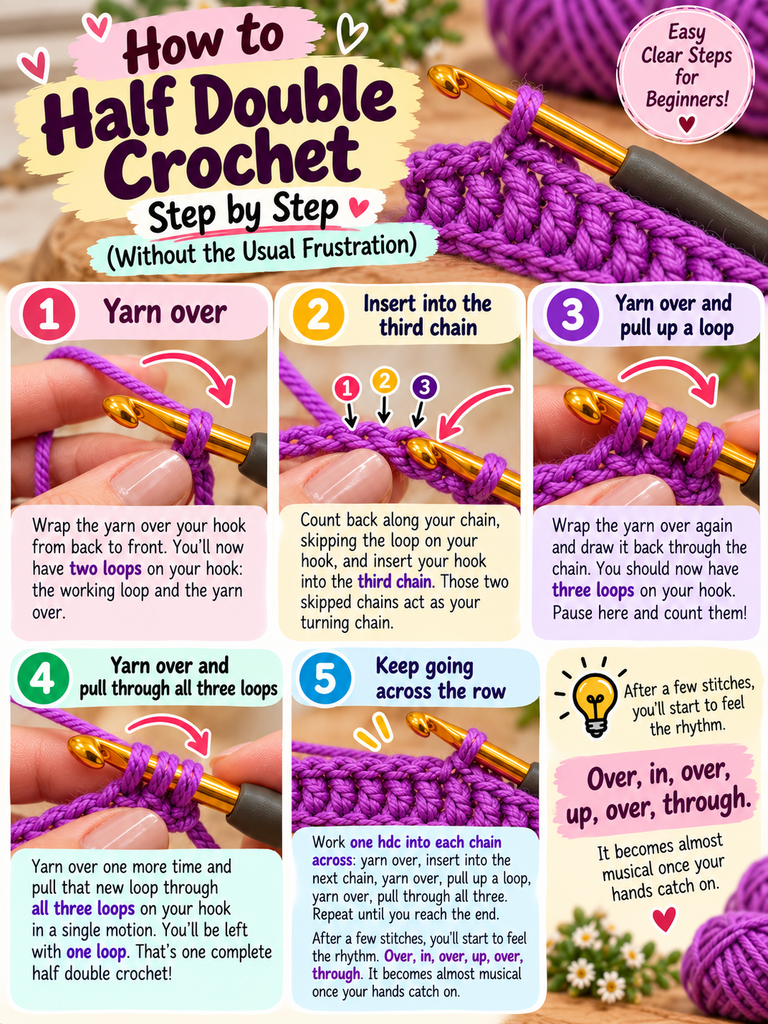
Step 1: Yarn over
Before you go into any stitch, wrap the yarn over your hook from back to front. You’ll now have two loops on your hook: the working loop and the yarn over.

This is the move that makes hdc different from single crochet. In single crochet you go straight into the stitch. Here, you yarn over first.
Step 2: Insert your hook into the third chain from the hook
Count back along your chain, skipping the loop on your hook, and insert your hook into the third chain. Those two skipped chains act as your turning chain, giving the first stitch the height it needs.

Step 3: Yarn over and pull up a loop
Wrap the yarn over again and draw it back through the chain. You should now have three loops on your hook.

Pause here and count them. Seriously. Three loops is your checkpoint, and it’s the moment where most mistakes show up.
Step 4: Yarn over and pull through all three loops
Yarn over one more time and pull that new loop through all three loops on your hook in a single motion. You’ll be left with one loop.
That’s it. That’s one complete half double crochet.

It might feel a bit snug the first few times. Give the loops a little room by gently pushing them down the hook’s shaft before you pull through. A relaxed grip helps more than you’d expect.
Step 5: Keep going across the row
Work one hdc into each chain across: yarn over, insert into the next chain, yarn over, pull up a loop, yarn over, pull through all three. Repeat until you reach the end.
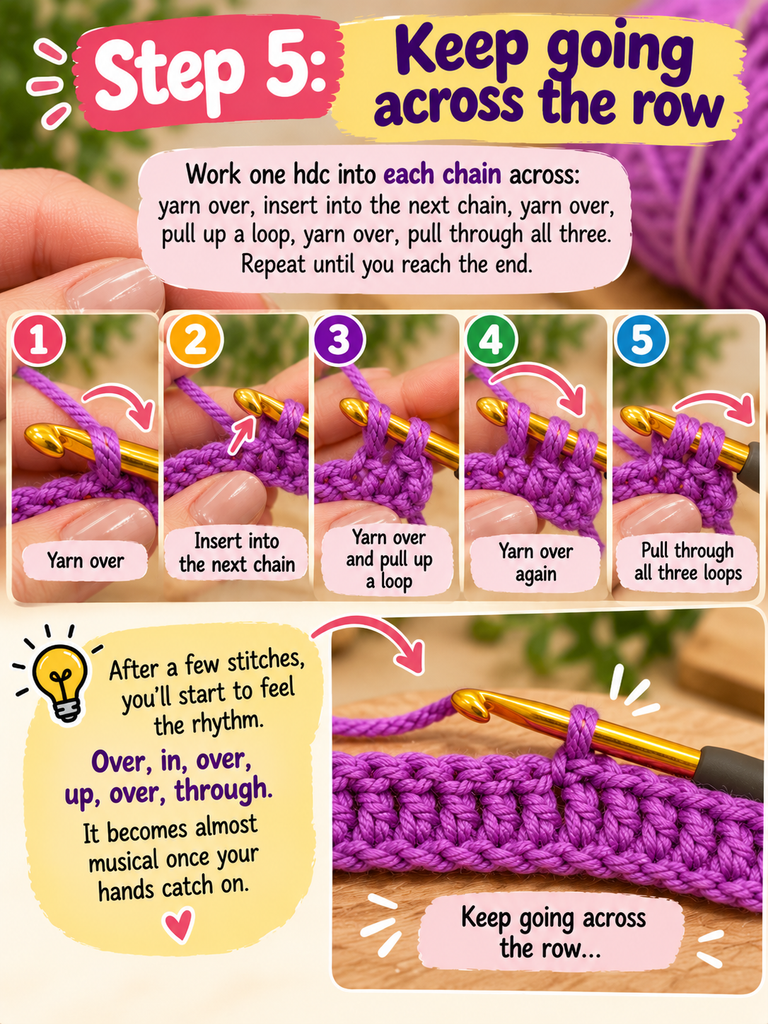
After a few stitches, you’ll start to feel the rhythm. Over, in, over, up, over, through. It becomes almost musical once your hands catch on.
Turning Your Work and Starting the Next Row
Now for the part that causes the most head-scratching: the second row.
When you reach the end of your first row, chain 2, then turn your work so the back is facing you. That chain-2 is your turning chain. It lifts your yarn up to the height of an hdc so your edges stay straight.
Here’s where patterns vary. Some designers count the chain-2 as your first stitch, so you skip the first stitch and work into the next one. Others don’t count it, so you work your first hdc right into the first stitch. Neither is wrong. Just check your pattern’s notes and stick with one approach the whole way through.
If you’re practicing on your own, I’d suggest the “doesn’t count” method. In my experience, it gives a cleaner, tidier edge for beginners, and it’s easier to keep your stitch count consistent.
For every stitch after the turning chain, insert your hook under both loops at the top of the stitch below (the little “V” shape), unless your pattern says otherwise.
Common Half Double Crochet Mistakes (And How to Fix Them)
We’ve all been there. You finish a few rows, step back, and something just looks… off. These are the issues I see most often, and every one of them is easy to fix.
Your edges are slanting inward
This almost always means you’re missing the last stitch of each row. That final stitch can hide right under the turning chain from the previous row. Count your stitches at the end of every row for a while. It feels tedious, but it saves hours of frogging later.
Your edges are growing outward
The opposite problem: you’re adding stitches. Usually this happens when you work into the turning chain and into the first stitch, giving you an extra one. Decide whether your turning chain counts and stay consistent.
The stitches are too tight to work into
Pulling through three loops at once needs a bit of slack. If you’re struggling, loosen your tension slightly or go up half a hook size. Tight hdc fabric also tends to curl, which is another sign to relax.
You ended up with a stitch that looks too short or lumpy
Check whether you pulled through all three loops in one go. If you pull through two and then one, you’ve accidentally made something closer to a double crochet’s finishing move, and the stitch won’t look right. Three loops, one pull.
Easy Variations Once You’ve Mastered the Basics
What I love most about the half double crochet is how much personality it picks up with tiny changes. Once the basic stitch feels natural, try these:
- Back loop only (hdc blo): Work into just the back loop of each stitch for a ribbed, stretchy texture. Great for hat brims and cuffs.
- Third loop hdc (camel stitch): The hdc has a hidden third loop just below the top “V” on the back side. Working into it creates a horizontal line that looks surprisingly like knitting.
- Half double crochet two together (hdc2tog): A simple decrease. Yarn over, insert into a stitch and pull up a loop, then yarn over, insert into the next stitch and pull up a loop, then yarn over and pull through all loops on your hook.
- Herringbone hdc: A slanted, braided-looking version that adds a lovely diagonal texture to scarves and blankets.
None of these need you to learn a new skill from scratch. They’re all built on the same handful of moves you just practiced.
Frequently Asked Questions
What’s the abbreviation for half double crochet?
In US patterns, it’s hdc. In UK patterns, the same stitch is the half treble crochet, written htr.
How many chains do I use for a half double crochet turning chain?
Two. Chain 2 at the start of each row, and when working into a foundation chain, start your first hdc in the third chain from the hook.
Is half double crochet good for beginners?
Absolutely. It’s usually the second or third stitch people learn, right after single crochet. It’s quick, forgiving, and makes warm, sturdy fabric.
What’s the difference between half double crochet and double crochet?
In a double crochet, after pulling up a loop you have three loops on your hook and you finish them in two steps (through two, then through two). In a half double crochet, you finish all three loops in one pull. That’s why it’s shorter.
Your First Project Idea
The best way to make the half double crochet stick is to use it on something real. A simple washcloth is perfect: chain 25, work hdc rows until it’s roughly square, and you’re done. It’s small enough to finish in an evening, and you’ll get dozens of rows of practice without feeling like you’re “just practicing.”
Once that feels easy, a plain hdc scarf or a basic beanie is a lovely next step.
Final Thoughts
Remember that leaning fence of a first row I mentioned? It’s still in a drawer somewhere. I keep it because it reminds me that every confident stitch started out as a clumsy one.
The half double crochet really comes down to a short, repeatable rhythm: yarn over, insert, yarn over, pull up a loop, yarn over, pull through all three. Count your loops, count your stitches, and give yourself permission to be a little messy at first. Your hands will learn faster than you think.
Now It’s Your Turn
Grab your hook, chain 15, and make your first row of half double crochet today. Then come back and tell me in the comments how it went. Was the three-loop pull-through the tricky part, or was it that sneaky last stitch? And if you’ve already got the basics down, let me know which variation you’d like a full tutorial on next.
Happy hooking!